

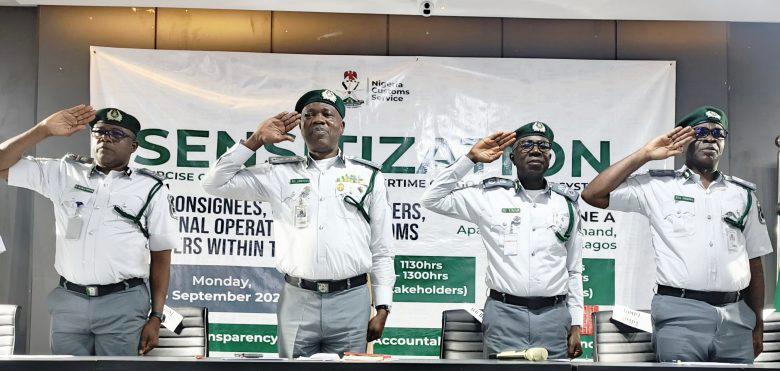
The Comptroller-General of the Nigeria Customs Service (NCS), Bashir Adewale Adeniyi MFR, has disclosed that more than half of the complaints he receives daily are related to overtime cargoes congesting Nigerian ports.
This revelation was made during a stakeholders’ sensitization exercise at Apapa Customs Command, where Adeniyi emphasized the need for efficient port operations.
The Burden of Overtime Cargoes
Adeniyi explained that overtime cargoes are a significant challenge, with some cases dating back nearly 15 years. Despite collecting N6.3 trillion in revenue in 2024, less than 1% came from overtime cargo sales.
The Customs boss stressed that the Service’s goal is not revenue from auction sales but efficient port operations.
New Automated System
To address the issue, the NCS has introduced a new automated system designed to balance the interests of cargo owners, custodians, and other stakeholders while speeding up clearance times and cutting costs.
The system aims to :
Enhance Transparency*: Improve data integrity and reduce human interference
Eliminate Bottlenecks*: Streamline clearance procedures and harmonize documentation
Prevent Exploitation*: Intelligence units will stay alert to prevent deliberate cargo abandonment
Stakeholder Engagement
The NCS has promised to engage with stakeholders, including terminal operators and shipping companies, to ensure smooth implementation of the system.
Special desks have been set up in headquarters and key commands to fast-track the clearance of imports for government projects, manufacturers, embassies, and international agencies .
Benefits of the Automated System
The Assistant Comptroller-General of Customs, Isah Umar, described the automated system as a defining moment that would break long-standing barriers in the management and disposal of overtime cargo.
The benefits include ¹:
Greater Transparency
Improved Data Integrity
Elimination of Bottlenecks
Reduced Human Interference
Harmonized Documentation
By implementing this new system, the NCS aims to reduce port congestion, increase efficiency, and enhance trade facilitation.
