

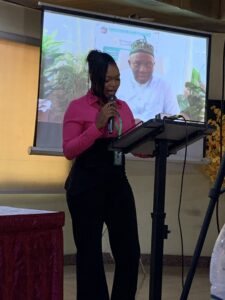
 At the 9th edition of National Economic Growth Forum (NEGF) round table organized by Adisa Olamillekan today 11th of June 2016 at Rockview Hotel in Apapa.
The conference hall was full when Abdulazeez Mariam stepped up to speak.
On behalf of Mickey Excellency Nigeria Limited, he had one lesson to teach the gathering of CEOs, business leaders, and policymakers: if Nigeria wants lasting prosperity, it must learn to grow its own economy from the inside out.
Hajia Bola Idayat Muse and Engr. Dr. Michael Sese Atina presided as chairpersons, but the message was for everyone. Mariam opened with a simple instruction: treat indigenous investment as the foundation, not an afterthought.
*Lesson 1: Build the Foundation First*
“Every strong economy starts at home,” he told the audience. Think of indigenous businesses as the base of a building.
They create jobs, pay taxes, develop skills, and keep wealth circulating locally. When Nigerians invest in Nigeria, the benefits stay in the community.
He reminded the room that Nigeria has tried this before. The Indigenization Policy of the 1970s was an early attempt to shift ownership and control to Nigerians. It had flaws, but the principle still stands: a nation cannot prosper if its citizens only watch while others run the economy.
*Lesson 2: Balance Foreign Investment with Local Protection*
Mariam didn’t argue against foreign investors. “Foreign capital, technology, and expertise are valuable,” he said. The instruction here is balance. Welcome foreign partners, but don’t let them crowd out local players.
He used logistics as the classroom example. International firms now handle everything from shipping to last-mile delivery. That’s healthy competition, but only if the rules are fair.
Right now, Nigerian logistics firms face high costs, multiple taxes, poor infrastructure, and policy uncertainty, while foreign firms leverage global networks and advanced tech.
The instruction: fix the playing field. Strengthen regulations, reduce multiple taxation, improve infrastructure, and enforce policies so local companies can compete without being pushed to the margins.
*Lesson 3: Guard Against Market Takeover*
Mergers and acquisitions can help industries grow, Mariam explained. But without guardrails, they can also erase local players. If foreign firms control the entire supply chain, Nigerians risk becoming consumers in their own market instead of producers and owners.
The instruction: regulate strategic sectors. Protect space for indigenous enterprises so they can participate at every stage, from manufacturing to delivery. Otherwise, wealth and decision-making move abroad.
*Lesson 4: Innovate or Be Left Behind*
The final instruction was on innovation. “Innovation is not just for tech companies,” Mariam said. It’s finding better, cheaper, smarter ways to do business. In logistics, that means digital tracking, automated customs, and e-commerce platforms.
Nigeria has the human capital for it. Young entrepreneurs are already building solutions. The instruction to government and business leaders: support research, fund startups, adopt technology, and reward ideas that solve local problems.
*The Takeaway*
Mariam closed with a clear directive for the audience of business leaders and policymakers: encourage local investment, protect private enterprise, enforce fair competition, and back innovation.
Do all four, and Nigeria builds an economy where indigenous businesses thrive, foreign partners add value, and growth lasts beyond one administration.
“If we get this right,” he said, “Nigeria won’t just consume. Nigeria will produce, own, and lead.”
As the session ended under the watch of Hajia Muse and Engr. Dr. Atina, the instruction was unmistakable: national development is a lesson Nigeria must practice daily.
