

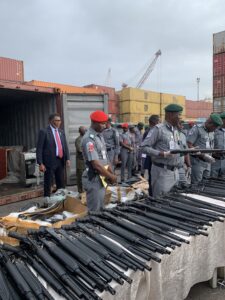
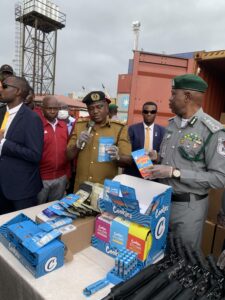
The Nigeria Customs Service, NCS, has recorded major seizures at the Tin Can Island Port Command, intercepting components used to assemble 140 pump-action rifles and two 40-foot containers of cannabis-infused products valued at ₦373,802,640.
Comptroller-General of Customs, Bashir Adewale Adeniyi, disclosed the interceptions during a press briefing, describing the operations as proof of the Service’s commitment to prompt enforcement and border security.
According to the CGC, Container No. TEMU 184536/9, which arrived aboard MV VELIKA on July 8, 2026, was flagged by Customs’ risk management system.
Following surveillance and physical examination, officers uncovered concealed crates containing JoJeff pump-action rifle parts.
Swift investigation led to the arrest of a suspect on July 31 at Migfo Bonded Terminal. Financial and telecom records linked him to the consignee.
Two suspects are currently in custody while efforts are ongoing to apprehend another principal suspect.
In a separate operation, Customs officers also intercepted two containers concealed with illicit cannabis products hidden among used vehicles, generators, fabrics, batteries and cables.
Items seized include:
109 cartons of Delta-8 cannabis pre-roll cookies* – 8,720 pieces, 17.44kg, valued at ₦308,792,640
125 cartons of Delta-8 cannabis gummies* – 740 packs, 515.2kg, valued at ₦40,700,000
73 cartons of cannabis cookies* – 442 packs, 309.4kg, valued at ₦24,310,000
The total street value of the narcotics is ₦373,802,640.
Ports Will Not Be Safe Havens
Adeniyi commended the Tin Can Island Port Command and the Enforcement Unit for their vigilance and professionalism. He also acknowledged the support of sister security agencies.
“Nigeria’s ports will never be safe havens for illicit weapons, narcotics, or prohibited goods,” the CGC declared. “We will relentlessly pursue all individuals connected to these smuggling operations.”
He urged the public to provide credible intelligence to help Customs sustain its fight against smuggling and threats to national security and public health.
