


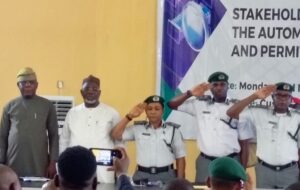

The Nigeria Customs Service (NCS) has launched a new automated system for processing licences and permits, aimed at modernizing its operations and improving service delivery.
The sensitization programme, held today 23rd of February 2026, at the Customs Training College Auditorium in Ikeja, Lagos, will acquaint stakeholders with the new digital system before its full implementation .
The automation is designed to eliminate longstanding bottlenecks associated with manual processing, allowing importers, clearing agents, and freight forwarders to apply for or renew licences and permits digitally from any location.
The system will provide real-time tracking of application status, reduce costs, and save time for trade operators.
Key Benefits of the Automated System:
Faster Processing: Applications will be processed faster, with real-time tracking of status
Increased Transparency: The process will be fair, consistent, and error-free
Improved Revenue Generation: Every licence and permit issued will translate into revenue for the federal government
Enhanced Efficiency: Officers will be able to process more documents in less time with greater output
The NCS has already trained officers across various Customs Area Commands ahead of the rollout.
Stakeholders, including the Association of Nigerian Licensed Customs Agents (ANLCA) and the National Association of Government Approved Freight Forwarders (NAGAFF), have commended the initiative, describing it as long overdue .

Speaking at the event, the Zonal Coordinator in Charge of Zone A’ Assistant Comptroller General of Customs, Muhammed Bababdede said the Comptroller General of Customs, Adewale Adeniyi approved the new system in response to the long-standing need to make Customs processes faster, more transparent, and easier for stakeholders.
He said the new automated system when implemented will address the challenges of paperworks, long queues, and the uncertainty that comes with manual processing.
According to him, with the new system stakeholders need not travel to Customs command or headquarters to apply for or renew their license permit as the process can be completed from the comfort of their office. “For many years, stakeholders have had to deal with paperwork, long queues, and the uncertainty that comes with manual processing. Those days are coming to an end, ” he said.
Babandede said the sensitisation exercise will be held across all Customs’ zones: to make sure that every stakeholder understands the new automated system before it is implemented.
“For stakeholders, automation means that you will no longer have to go to a Customs office simply to apply for or renew a licence or permit. You will be able to do this from your office or even from your phone.
“It means your applications will be processed faster. It means you will be able to track the status of your application in real time.
And it means that the process will be the same for everyone — fair, consistent, and without the risk of error that comes with manual records.
“For the Service, automation means better record keeping, easier supervision, and the ability to serve more sakeholders at once without increasing the burden on our officers, ” he said.
In her welcome address, Comptroller of Customs, License and Permit Unit, Tariff and Trade department, Ngozika Anozie said the automated system will bring about ease of doing business in the maritime sector and boost revenue generation for the Service and the government.
She added that the new system will save time and minimize fraudulent practices in the system, as every single document that is uploaded will be automatically rejected by default if it is fake and accepted if it is genuine.
“Automation will cut the cost of doing business and minimize movement risks for our stakeholders.
They would no longer be jumping on buses or flights to and fro Customs Headquarters-Abuja, paying hotel bills plus feeding for days, to obtain or renew their licenses and permits.
“License and Permit can now view assessments through the B’Odogwu to be sure that any company applying for fresh or renewal of licences or permits is not having unpaid assessments hanging on it.
The CGC is poised to sanitize the system and we, at License & Permit Unit are very passionate about this, to ensure that the objective is achieved.
“Our stakeholders will now have the luxury of using the time they would have expended running from one Command to the other or to Customs headquarters Abuja, to achieve other equally useful objectives in their business value chain that would impact the growth and expansion of their businesses.
“Ultimately, this automation will enhance the statutory revenue generation duties of the Nigeria Customs Service, because fees are paid into the coffers of government with every single licence and permit processed; imports are made with the permits, the clearing processes are stamped with the licences given and obviously, revenue is generated.
So, the more licences and permit we issue or renew, the more revenue we would generate for NCS and Nigeria economy, ” she said.
The event attracted a broad cross-section of trade stakeholders, including the Vice President of the Association of Nigerian Licensed Customs Agents (ANLCA), Prince Segun Oduntan, the National Secretary of the National Association of Government Approved Freight Forwarders (NAGAFF), Fwdr Godfrey Nwosu, and the Chairman of Customs Consultative Committee (CCC) Alhaji Hakeem Olanrewaju, among others.
Would you like to know more about the impact of automation on Nigeria’s trade sector or the implementation timeline for the new system?
