

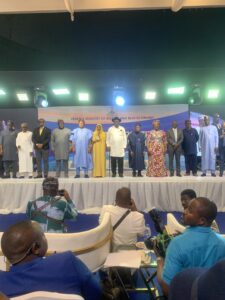
The Minister of Marine and Blue Economy, Dr. Adegboyega Oyetola, has urged state governments, private investors and development partners to work more closely with the Federal Government to unlock the enormous economic opportunities within Nigeria’s marine and blue economy sector.
Speaking at the Second Quarter 2026 Citizens’ and Stakeholders’ Engagement organised by the Federal Ministry of Marine and Blue Economy in Lagos on Thursday, Oyetola said the country must now shift from policy discussions to practical implementation that delivers jobs, investment and sustainable economic growth.
The event, held at Eko Hotel and Suites, Victoria Island, was themed “From Policy to Action: Mobilising Sub-National Governments for Effective Implementation of Nigeria’s National Policy on Marine and Blue Economy.” It attracted government officials, development partners, diplomats, academics, industry stakeholders and representatives of state governments.
According to the minister, while the National Policy on Marine and Blue Economy provides a clear roadmap for developing Nigeria’s maritime resources, meaningful progress will only be achieved through stronger collaboration with states where many of the country’s coastal and inland water resources are located.
He noted that greater state participation would help attract investments, create employment opportunities, strengthen food security and promote environmental sustainability across coastal communities.
Oyetola also highlighted achievements recorded under President Bola Ahmed Tinubu’s Renewed Hope Agenda, including improved stakeholder engagement, increased investment in the maritime sector, enhanced safety on inland waterways and better port competitiveness.
He referenced the 2025 Container Port Performance Index released by the World Bank and S&P Global Market Intelligence, which ranked Tin Can Island Port as the world’s tenth most improved port and Lagos Port Complex, Apapa, as the twelfth most improved between 2020 and 2025.
The minister added that ongoing port modernisation and plans to develop new deep seaports in Akwa Ibom, Bayelsa, Cross River, Lagos and Ondo states would strengthen Nigeria’s ambition of becoming West Africa’s leading maritime hub.
On water transportation safety, Oyetola disclosed that the ministry had intensified collaboration with relevant agencies and state governments by distributing life jackets nationwide while encouraging states to phase out unsafe wooden passenger boats in favour of modern fibre boats.
He further appealed to coastal states to align their development plans with the national blue economy policy and create a conducive environment for investments in fisheries, aquaculture, maritime transport, tourism, shipbuilding, renewable energy and marine biotechnology.
Delivering the keynote address, Bayelsa State Governor, Senator Douye Diri, commended President Tinubu for creating the Ministry of Marine and Blue Economy, describing it as a bold step towards diversifying Nigeria’s economy.
Diri revealed that Bayelsa established its own Ministry of Marine and Blue Economy in June 2024 and has since commenced large-scale fish production at the Bayelsa Aquaculture Village in Yenegwe, where high-quality catfish fingerlings and juveniles are being produced to improve food security and create employment.
The governor also said the state had expanded its marine transport system and was actively pursuing the development of the proposed Agge Deep Seaport to serve as a major maritime gateway for the Niger Delta.
He urged coastal states to establish dedicated marine ministries, enact supportive laws, secure their maritime assets, invest in credible data systems and develop skills, logistics infrastructure and innovation hubs to maximise opportunities within the blue economy.
Also speaking at the event, President and Chief Executive Officer of Dangote Industries Limited, Aliko Dangote, represented by the Managing Director of Dangote Port Operations, Simeon Akin Omole, stressed that private sector investment would determine the success of Nigeria’s blue economy policy.
Dangote said the policy aims to create three million jobs within four years, achieve annual sectoral growth of seven per cent and ensure that at least half of all new jobs benefit young Nigerians between the ages of 18 and 35.
He identified policy consistency, quality infrastructure, access to finance and investor confidence as essential ingredients for industrial growth, adding that infrastructure development, value-chain expansion and strong public-private partnerships would unlock the sector’s vast potential.
Dangote further described fisheries as one of Nigeria’s biggest untapped investment opportunities, noting that the country still spends close to one billion dollars annually on fish imports despite increasing local production.
According to him, greater investment in aquaculture, hatcheries, fish processing, feed production, cold-chain logistics and export infrastructure could significantly reduce imports, save foreign exchange, create over 500,000 jobs and position Nigeria as a leading fisheries exporter.
Goodwill messages were delivered by the Deputy Governor of Akwa Ibom State, Senator Akon Eyakenyi; Chairman of the Senate Committee on Marine Transport, Senator Wasiu Sanni Eshinlokun; representatives of the governors of Ondo and Borno states; as well as private sector stakeholders, all of whom reaffirmed their commitment to supporting the implementation of Nigeria’s marine and blue economy agenda.
