

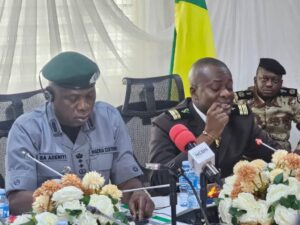
 SEME-KRAKE BORDER, SEPT 11, 2026— Eight years after it was commissioned, the ₦18.29 billion joint border post at Seme-Krake is still not truly “joint,” the Nigeria Customs Service has said.
Addressing stakeholders at the border on Friday , Comptroller General of Nigeria Customs Service, Dr Bashir Adewale Adeniyi said the concrete and buildings were completed years ago, but the one thing that makes it a joint border — real-time data integration — is still missing.
His words:
“This is a border post sharing a car park”
The facility was approved in 2003 by ECOWAS Heads of State under the Trade, Road, Transport and Transit Programme.
Construction started in 2011 and was funded by the European Union under the 3rd European Development Fund at a cost of almost *18.29 million euros* on a 17-hectare site.
It was commissioned in 2018 by the late President Muhammadu Buhari and former President Patrice Talon. In 2022, Nigeria and Benin signed a bilateral agreement for its operationalisation.
Today, the site has lanes, parking, offices, weighbridges, and scanners. But according to Customs, “what was never delivered was the thing that makes a joint border post a joint one.”
“Two administrations presently work under one roof, but they do not work with one system,” the NCS CG said. “There is still no seamless real-time exchange of declarations, manifest, transit information, risk profiles, and cross-border alerts.”
“In very clear terms: without interconnectivity, this is not a joint border post. It is a border post sharing a car park at best. The concrete was the easy part. The integration is the hard part.”
The Fix: One System, One Border
Customs said work is now underway to interconnect both administrations through a common data exchange arrangement.
The goal: a declaration lodged on one side is visible on the other in real time. Transit can be tracked from origin to destination. And risk alerts raised by one country reach the other while still useful.
The service also listed other critical gaps:
Restore scanning: Scanners are currently down, forcing manual examination of every crate.
Security upgrade: Strengthen access control, surveillance, lighting, and coordinated patrols.
Joint procedures: Bilingual, standardized processes for cargo, passengers, inspection, and incident escalation.
Joint risk management: Focus resources on high-risk consignments, not everything.
Joint management: A properly empowered structure with funding and preventive maintenance.
Order: Dedicated lanes, holding areas, signage, and a regulated market space.
“The objective is to achieve a model, technology-enabled joint border post,” the official said. “If we achieve that here, we will have built the template for every other crossing within ECOWAS and the African continent”.
New Facility for Women Traders
Customs also announced a dedicated facility for women cross-border traders, who make up more than 70% of informal trade in Africa.
On this corridor, 22% of Benin’s informal exports go to Nigeria. Informal trade accounts for about one-fifth of Nigeria’s economy and an even higher share in Benin.
Studies show a woman trading across a West African border typically supports more than 3 children and other dependents. But they also face harassment, extortion, and delays.
“Where a border is slow, opaque, intimidating, the trader with the least capacity to absorb costs is the one driven around it. And once she is driven around it, we lose her twice. She loses the protection of the law and the state loses the revenue,” Adeniyi said.
The new facility will simplify procedures for small consignments, provide information in local languages, offer accessible contacts, protection against illegal demands, and a complaints channel to bring more women into the formal system .
Benin Customs Director-General, Col. Raouf Malehhossou Aboudou, commended the initiative, describing it as pragmatic and purposeful in recalibrating joint operations to facilitate trans-border trade.
The Seme Customs Area Controller, Comptroller Abdullahi Shuaibu Kaila, also pledged the command’s commitment to supporting seamless trade across the corridor.
The new facility will simplify procedures for small consignments, provide information in local languages, offer accessible contacts, protection against illegal demands, and a complaints channel to bring more women into the formal system.
The launch event featured a facility inspection, demonstration of the border modernization solution, and a symbolic football match between the Seme Area Command team and Badagry United Football Club, with the Command securing a 2–0 victory.
Customs said Seme-Krake must now be treated as “a strategic modernisation programme, not a series of isolated repairs.”
