

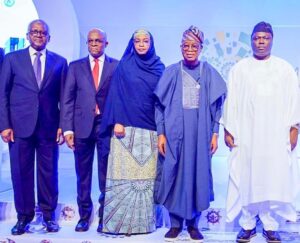
Nigeria is scaling up port capacity and pushing ahead with major maritime reforms to position itself as West and Central Africa’s leading trade and logistics hub, Minister of Marine and Blue Economy Dr. Adegboyega Oyetola has said.
Speaking at the opening of the Mid-Year Session of the Port Management Association of West and Central Africa Board of Directors in Lagos on Monday, Oyetola said federal approvals had been granted for new deep seaports to complement existing facilities and strengthen supply chain resilience.
“Approvals have therefore been granted for the development of additional deep seaports across the country to complement existing infrastructure, strengthen supply chain resilience, and reinforce Nigeria’s position as the preferred maritime and logistics hub for West and Central Africa,” he told delegates.
The meeting, themed _“Ports of the Future: Combining Logistical Resilience with Inclusive Community Development,”_ brought together port authorities, policymakers, and private sector leaders from across the sub-region.
Oyetola said the Tinubu administration remains committed to modernising ports through infrastructure upgrades, digital transformation, and improved operational efficiency.
He credited coordinated policy interventions and stronger inter-agency collaboration for cutting logistics bottlenecks at major ports, leading to faster cargo evacuation, reduced vessel waiting times, and a more predictable business environment.
He highlighted the Federal Government’s National Single Window initiative as a key reform to streamline cargo clearance by digitally integrating government agencies and port operations.
Existing ports will also undergo channel deepening and other upgrades to accommodate larger vessels.
“These upgrades are critical to ensuring that our ports remain globally competitive and capable of supporting larger volumes of trade in the years ahead,” the minister said.
On maritime security, Oyetola said the Deep Blue Project had eliminated piracy in Nigerian waters and significantly reduced crimes across the Gulf of Guinea, restoring investor confidence and enhancing the region’s reputation as a secure maritime corridor.
He urged delegates to advance initiatives that strengthen logistical resilience, promote sustainable port management, and link maritime activities to inclusive community development.
In his welcome address, Nigerian Ports Authority Managing Director and PMAWCA President Dr. Abubakar Dantsoho said the sub-region is experiencing a surge in maritime infrastructure investment, with over $27bn in port projects underway or recently announced.
He cited the $20bn Simandou-Morebaya project in Guinea, $2bn Port San Pedro in Côte d’Ivoire, and Nigeria’s $1.5bn Lekki Deep Sea Port, alongside ongoing upgrades at Apapa and Tin Can Island and a $600m investment by APM Terminals.
Dantsoho said ports must evolve beyond cargo gateways to become drivers of the blue economy, including renewable marine energy, aquaculture, sustainable fisheries, coastal tourism, and marine biotechnology.
The three-day session, running from 18 to 20 May 2026, was attended by Taraba State Governor Dr. Kefas Agbu, Lagos State Commissioner for Transportation Mr. Oluwaseun Osiyemi representing Governor Babajide Sanwo-Olu, Dangote Group Chairman Alhaji Aliko Dangote, and Presidential Adviser on Policy Coordination Hadiza Bala Usman.
